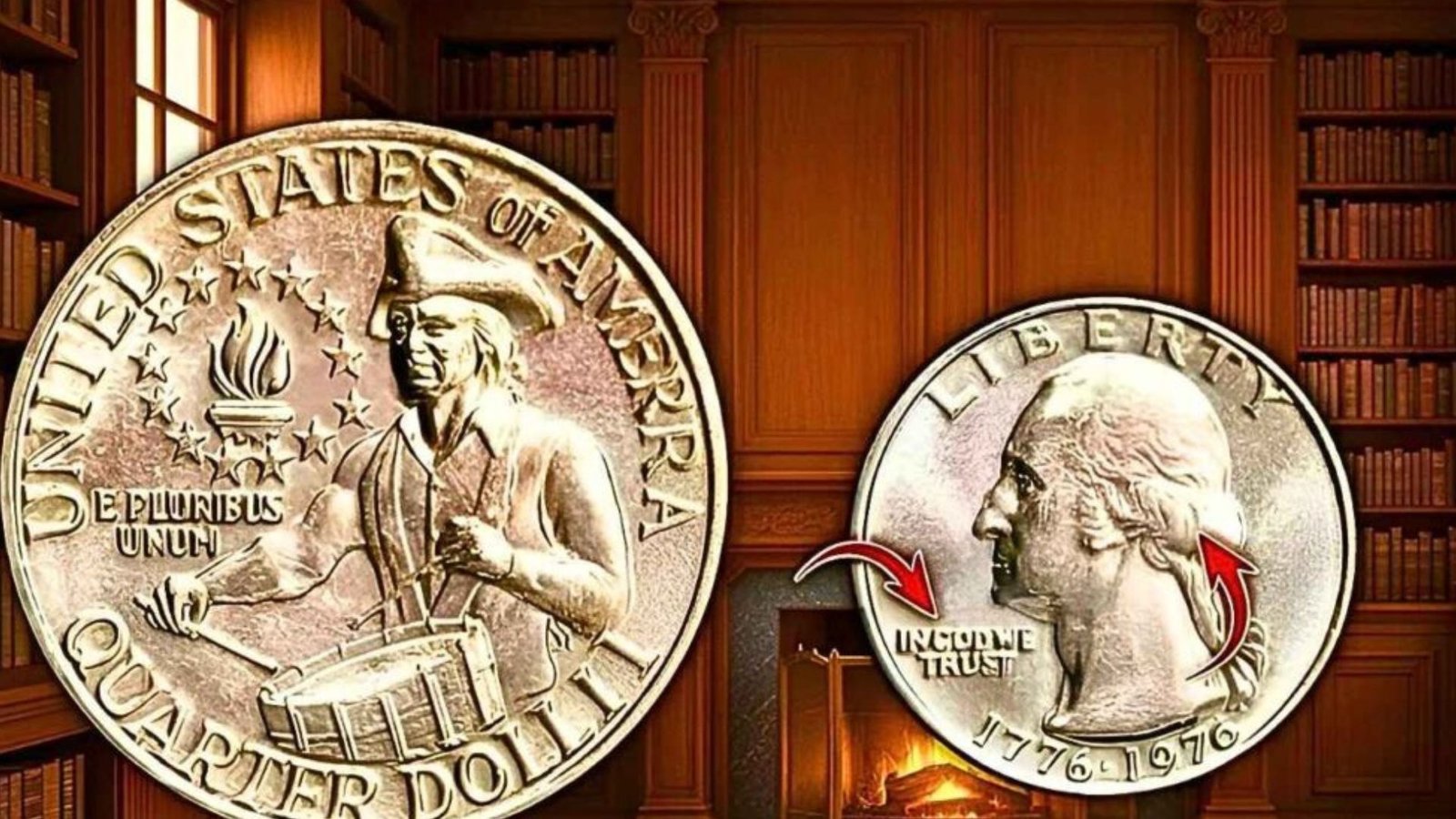
The 1976 Bicentennial quarter is one of the most famous U.S. coins ever made. Over 1.6 billion were produced to celebrate America’s 200th birthday, showing a colonial drummer on the back and the special dual date “1776–1976”. Most are worth exactly 25 cents, but a tiny handful have dramatic factory mistakes (errors) that collectors are going crazy for right now. Some have sold for $500, $2,000, even $10,000+ this year! Here are the seven hottest error types explained in super-simple words.
Why Bicentennial Quarter Errors Are Exploding in Value Right Now
- Social media is full of “I found a $5,000 quarter!” videos.
- Silver prices are high, so the 40% silver versions (made only in San Francisco) are already worth $6–$8 just for the metal.
- Only a few dozen of the best errors are known, so demand is huge.
The Top 7 Rare 1776-1976 Bicentennial Quarter Errors
1. 1976 No Mint Mark on 40% Silver Planchet (Wrong Metal Error)
Philadelphia coins should have no letter, but they were never supposed to be struck on silver blanks. A small number accidentally got the silver planchet meant for San Francisco. These weigh more and have a solid silver edge.
Current value: $3,000 – $10,000+
2. 1976-D Struck on a 40% Silver Planchet

Same mistake, but from Denver (“D” mint mark). Even rarer than the silver edge with a “D”.
Current value: $4,000 – $12,000
3. 1976-S Silver Double Die Obverse (Strong Doubling)
The front shows clear thick doubling on “IN GOD WE TRUST”, the date, and Washington’s face. You can see it without a magnifying glass.
Current value: $500 – $3,500
4. 1976 Bicentennial Quarter Struck 50–70% Off-Center
The design is way off to one side, sometimes cutting off half the drummer or Washington’s head, but the date is still visible. The crazier the shift, the higher the price.
Current value: $300 – $2,500
5. 1976-S Silver Proof Missing Clad Layer (Copper Wash Error)

A silver proof coin that somehow lost its outer nickel layer, showing reddish copper color. Looks like a penny material but weighs like silver.
Current value: $800 – $4,000
6. 1976-D Double Denomination on a Nickel Planchet
A quarter design accidentally stamped on a tiny 5-cent blank. The coin is quarter-sized design on nickel-sized metal – super weird and super rare.
Current value: $1,500 – $7,000
7. 1976 Bicentennial Quarter Struck Through Grease Filled Die
Letters or parts of the drummer are missing or weak because grease clogged the stamp. Strong “filled die” examples with missing “LIBERTY” or drummer’s face sell fast.
Current value: $150 – $1,200
| Rank | Error Type | Mint Mark | How to Spot It | 2025 Value (High Grade) |
|---|---|---|---|---|
| 1 | No Mint Mark on Silver Planchet | None | No letter + solid silver edge + heavier weight | $3,000 – $10,000+ |
| 2 | “D” on Silver Planchet | D | “D” mint mark + solid silver edge | $4,000 – $12,000 |
| 3 | Strong Double Die Obverse (Silver or Clad) | Any | Thick doubling on lettering & date | $500 – $3,500 |
| 4 | 50–70% Off-Center | Any | Design way off to one side, date still shows | $300 – $2,500 |
| 5 | Missing Clad Layer (Silver Proof) | S | Reddish copper color, mirror fields | $800 – $4,000 |
| 6 | Struck on Nickel Planchet | D | Quarter design on tiny nickel-sized blank | $1,500 – $7,000 |
| 7 | Filled Die / Missing Letters | Any | Parts of words or drummer missing | $150 – $1,200 |
How to Check Your 1976 Quarters in Under 1 Minute
- Look for the drummer and dual date “1776–1976”.
- Check the tiny letter above the date: none = Philadelphia, D = Denver, S = San Francisco (silver).
- Look at the edge: solid silver color = 40% silver (worth checking further).
- Weigh it on a cheap digital scale: silver = ~5.75 grams, normal = 5.67 grams.
- Use your phone magnifier to look for doubling, missing parts, or off-center design.
Conclusion: Your Coffee Can of 1976 Quarters Could Hold Real Money

In 2025, the once-common Bicentennial quarter has become one of the most exciting coins to hunt. While 99.99% are still only 25 cents, the seven dramatic errors above are setting new price records almost every month. Many of the $5,000–$10,000 coins were found by regular people checking old jars, bank boxes, and family collections. Grab every 1976 quarter you see – the next viral “error jackpot” could be in your house right now!